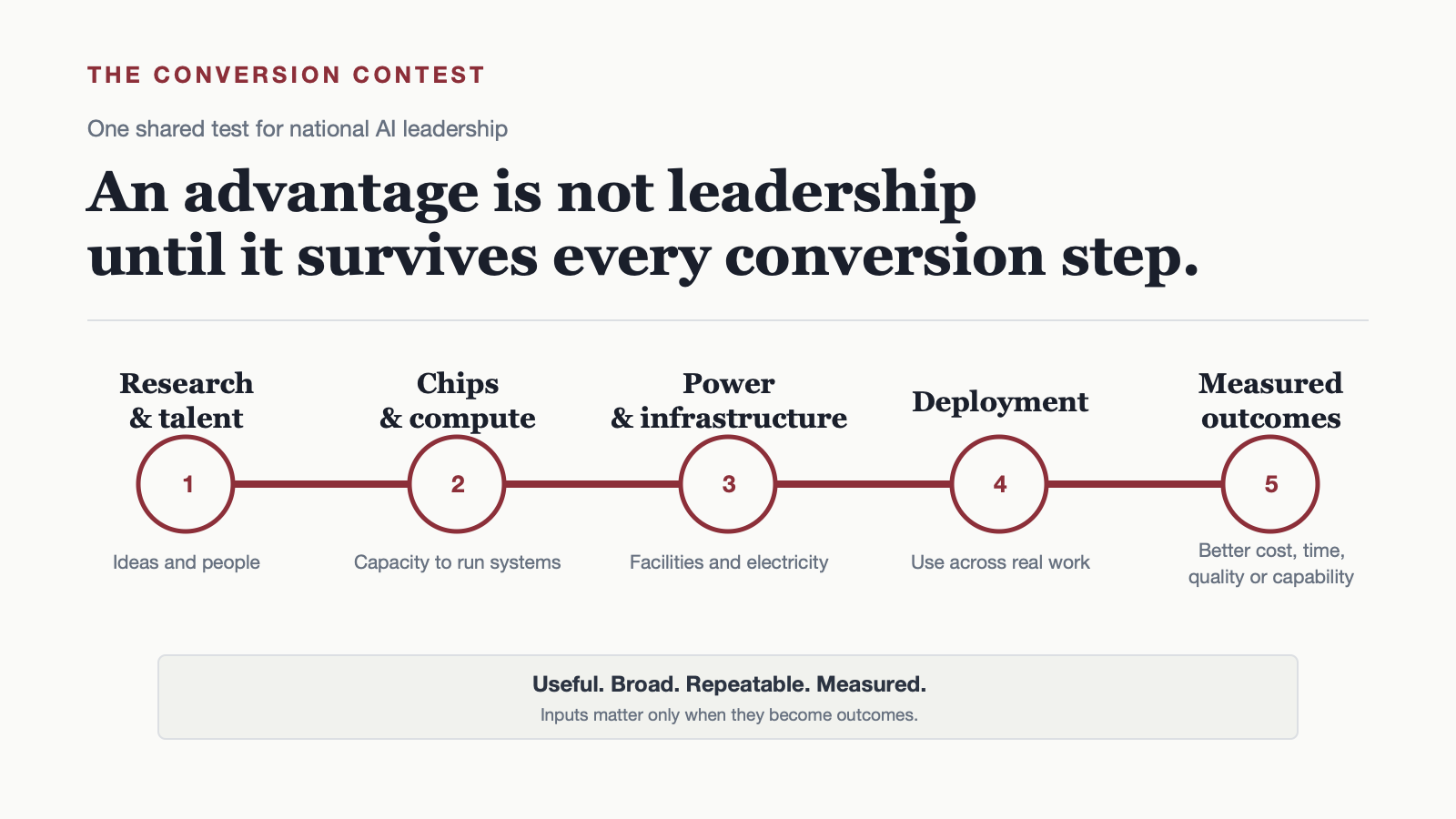
The contest between the United States and China in artificial intelligence is usually scored with the wrong numbers. One side points to advanced models, private investment and computing power. The other points to patents, users, factories and national coordination. All matter, but none alone tells us which country is turning AI into broad economic and strategic capability.
The better question is: Who can repeatedly convert research, talent, chips, electricity, capital and regulation into useful results across an economy? That requires the same test in manufacturing, healthcare, finance, transportation, energy, consumer services, government and national security: How much usable AI has actually been deployed? How broadly has it spread? Has it increased output, reduced cost or time, or improved quality or capability? Is the evidence national, or only one impressive company example?
The available evidence does not establish whether the United States or China leads in AI across the economy. The United States has the stronger frontier engine. China has the clearest demonstrated lead in large-scale industrial automation. In most other sectors, public evidence is not yet good enough for a fair national comparison.
America’s frontier advantage is not an economic guarantee
The United States begins with enormous advantages in private capital, advanced computing, cloud platforms and frontier laboratories. Stanford University’s 2026 AI Index reported that U.S. private AI investment reached $285.9 billion in 2025, compared with $12.4 billion in China. That is a major American advantage, but private-investment figures do not measure total national support.1 China uses national and local government-directed funds, while the United States supports AI through research, semiconductor policy, federal land, permitting, procurement and infrastructure financing.1, 2 A dollar-for-dollar comparison would be misleading because the two systems distribute and report public support differently.
American institutions produced more notable frontier models, but performance has converged quickly. Stanford’s March 2026 comparison put the leading U.S. model 2.7 percent ahead of the leading Chinese model. Artificial Analysis’s September 2026 benchmark scored the leading U.S. models at 53 and China’s GLM-5.3 at 45. The two benchmarks use different methods and should not be treated as one continuous series. China led in AI publication volume and citations, while Chinese inventors produced far more generative-AI patent families.3, 4, 12
Investment measures resources, a benchmark captures performance at one moment, and publications and patents show activity. None proves economic value. The United States still has the stronger frontier engine, but that advantage matters only when managers redesign work, employees can use the tools, customers trust the result and infrastructure arrives on time.
The American system excels at funding uncertain technical bets and turning research into global software platforms. Its weakness is assuming frontier success will spread automatically. Capital can buy experiments, chips and talent, but economic advantage arrives only when those resources improve a product, worker or public service at a sustainable cost.
China organizes these resources differently. It can bring government policy, industrial financing, local governments, suppliers and large domestic markets behind selected priorities. That can shorten the path from policy to physical deployment, but it can also produce waste and targets that never become useful output. The real comparison is not markets against planning. It is how well each system corrects mistakes and scales what works.
Manufacturing is China’s clearest deployment lead
Manufacturing provides the strongest evidence that China can convert policy, infrastructure and industrial scale into physical deployment. China accounted for 54 percent of worldwide industrial robot installations in 2024.1 The International Federation of Robotics reported that U.S. manufacturers had 307 industrial robots for every 10,000 employees and installed about 38,000 units in 2025. IFR estimated that China’s 2025 installations were roughly ten times the American total.1, 5
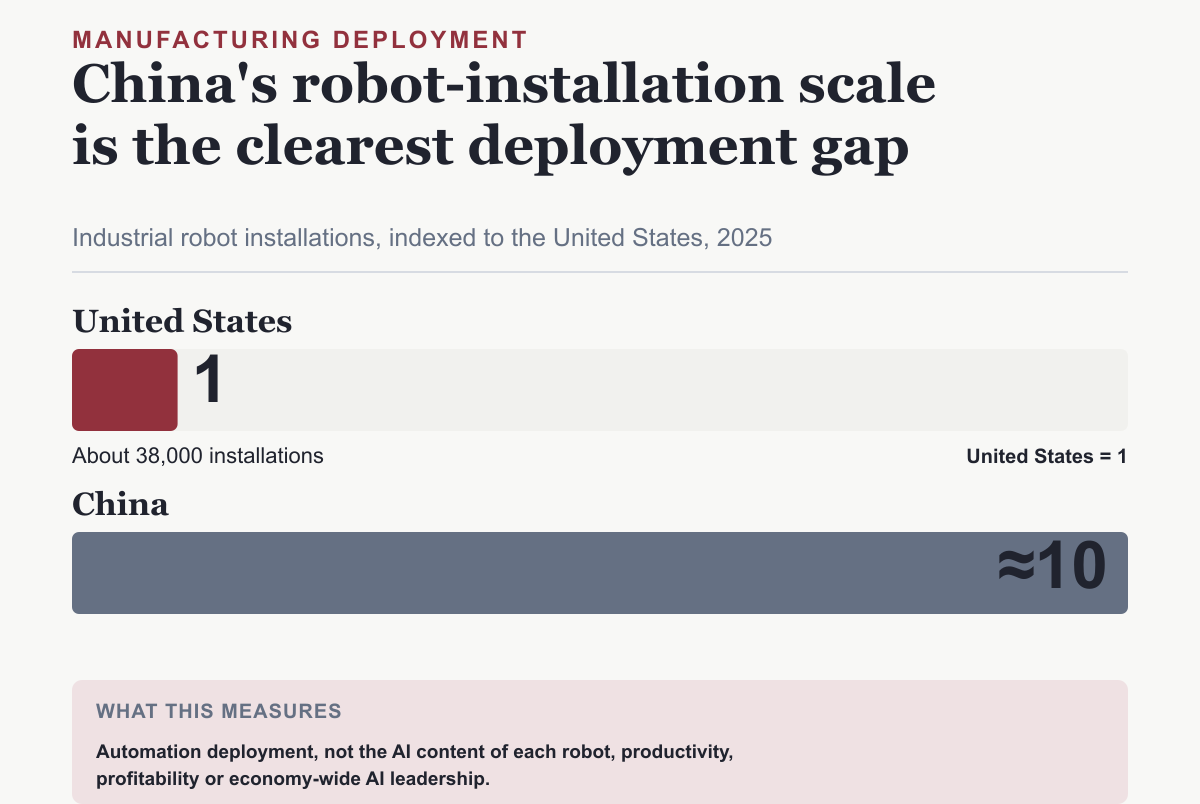
Not every industrial robot is advanced AI; many perform fixed tasks. Installations also do not prove that AI caused national productivity growth. They do show that China has built an unusually large system for financing, manufacturing, installing and operating automated equipment. This is the clearest physical evidence of China’s deployment lead, not proof of an economy-wide lead in AI adoption.
The lesson for America is not to copy every Chinese policy. It is to recognize that software leadership does not guarantee control of the machines, components, factories and trained workforce through which AI changes the physical economy. Investors should resist the opposite mistake: China’s robot volume does not make every installation efficient or profitable. The serious signal is the learning loop created by scale, as manufacturers, integrators and customers repeatedly learn how to redesign production and lower costs. That operating knowledge can become an advantage even when an individual machine is not exceptional.
The United States shows real diffusion in knowledge work
In finance, professional services and information businesses, the strongest national evidence comes from the United States. The U.S. Census Bureau found that 18 percent of firms used AI in a business function in late 2025 and early 2026, or 32 percent when weighted by employment. Among very large firms in information, professional services and finance, adoption reached roughly 50 to 60 percent.6
China may have equal or greater use in some functions, but commonly cited figures come from vendor surveys, selected companies, employee surveys or official user counts with different questions and samples. Placing them beside the Census result would create a false comparison. The evidence shows widespread AI use in large finance, professional-services and information firms. Public data do not establish which country has higher economy-wide business adoption.
For American business, the numbers expose a management challenge. Buying an AI subscription is easy. Rebuilding a process so people know when to trust the system, when to check it and who remains responsible is harder. The firms that capture value will be those that change workflows, train employees and measure whether work becomes faster, cheaper or better.
This is where the U.S. could convert its frontier advantage quickly. It already has deep professional expertise, enterprise software, cloud infrastructure and private capital. The opportunity is to combine those assets with sector knowledge. The risk is a two-speed economy in which large firms learn while smaller businesses and public institutions fall behind.
In healthcare and government, activity outruns proof
Both countries are moving AI into healthcare, but approvals and pilots are not patient outcomes. The U.S. Food and Drug Administration maintains a public list of AI-enabled medical devices that met applicable premarket requirements, while China’s regulator has made AI-powered devices and medical robots priority areas. Yet Stanford found that only a small share of studied AI medical devices had randomized trial evidence, and there is no matched national dataset showing which country’s hospitals use AI more broadly, save more time, reduce errors or improve outcomes.7, 8, 9 Naming a winner would confuse regulatory activity with clinical results.
Government presents the same problem. Eleven selected U.S. agencies reported 1,110 AI use cases in 2024, including 282 involving generative AI; the Government Accountability Office also documented governance weaknesses. China has extensive national and local programs, but no equivalent public inventory tied to processing time, error rates or service quality.10
The United States provides more information that the public can check. That is an advantage in transparency, not proof of better results. In healthcare, caution is not failure. A system affecting diagnosis or treatment should face a higher standard than a writing assistant. But regulation should create a path to trustworthy use, not leave hospitals trapped between uncontrolled experimentation and paralysis. The useful scoreboard is whether clinicians save time without losing accuracy and whether patients receive better care.
Government has the same conversion problem. An inventory shows activity and risk, but citizens experience outcomes: a benefit processed correctly, a permit issued faster, or fraud detected without blocking legitimate claims. Both countries have incentives to announce AI programs. Far fewer systems report whether those programs improved service.
Energy and compute reveal different constraints
AI depends on chips, data centers, cooling, communications networks and electricity. The International Energy Agency estimated that the United States accounted for 45 percent of global data-center electricity use in 2024, compared with 25 percent for China. These figures cover all data-center workloads, not only AI, but show that America has the larger operating base.11
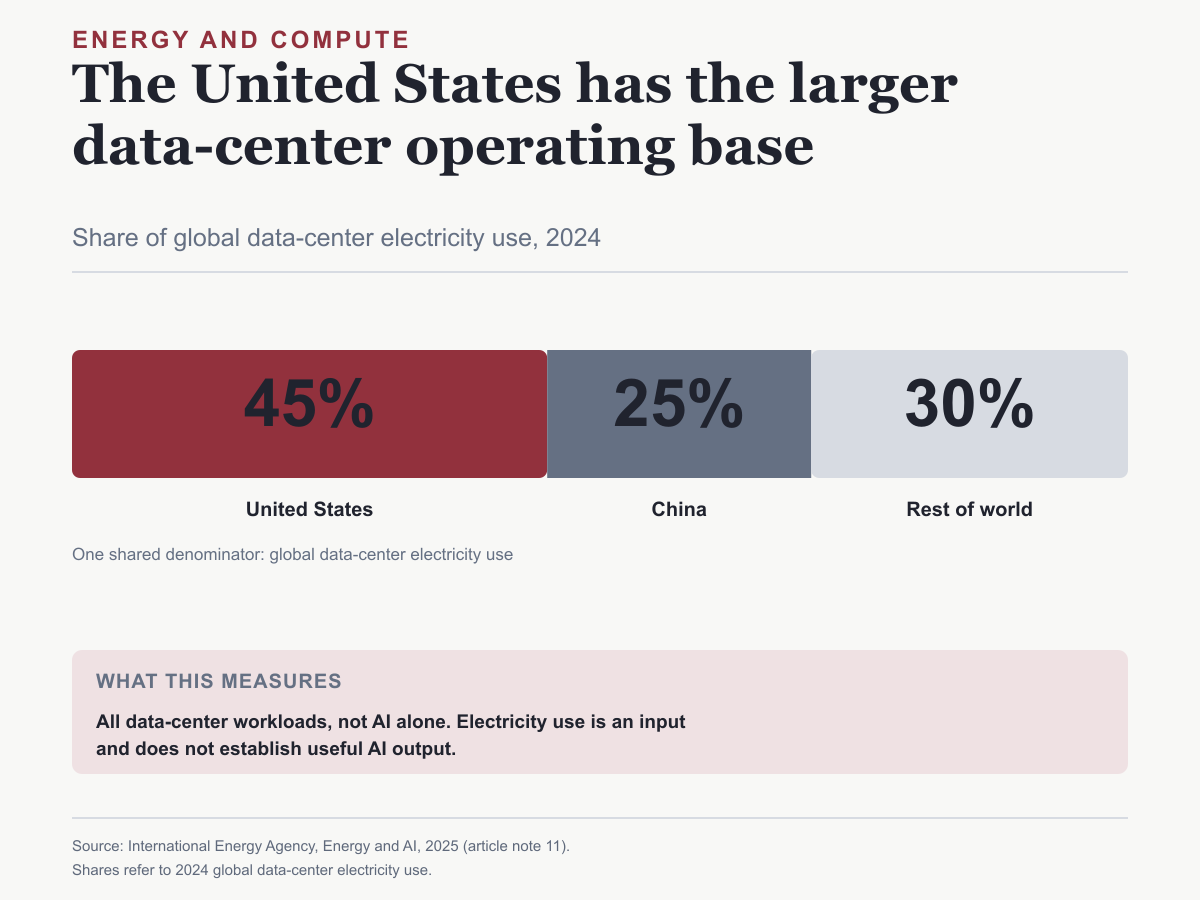
America also has better access to leading AI accelerators. China faces advanced-chip restrictions, but those limits encourage efficiency and domestic alternatives. Both systems remain dependent on international supply chains, especially advanced fabrication in Taiwan.3
China may build electricity and industrial infrastructure faster through centralized coordination. U.S. government support is real, but it is divided among federal agencies, states, local governments, utilities and permitting jurisdictions.2 The United States can mobilize more private capital but faces fragmented transmission and approval decisions. Energy consumed remains an input; the advantage belongs to the country that produces more useful capability per dollar, chip and unit of electricity.
A delayed transmission line can matter as much as an algorithmic improvement. So can shortages of transformers, cooling equipment or skilled electricians. American developers can announce enormous projects quickly, and investors can fund them, but a project announcement does not mean the power is connected. China can coordinate construction more directly, but capacity is not valuable if it supports inefficient or unwanted applications.
The United States needs faster, predictable approvals for generation and transmission, resilient equipment supply chains and incentives to measure useful computing output rather than celebrate raw electricity demand. Efficiency is a strategic capability, not merely a response to scarcity.
What the United States must do
The United States should not try to copy China’s system or assume private markets will solve every coordination problem. It should strengthen the parts of its system that work and repair the connections between them.
First, America should measure outcomes. Statistical agencies should track AI use, productivity, workforce change and sector performance with consistent definitions. Public funding and procurement should require evidence of time saved, cost reduced, quality improved or capability delivered. Better measurement would also help investors distinguish durable businesses from firms selling an AI label.
Second, it should make physical deployment easier. That means faster, more predictable decisions for power generation, transmission, data centers and advanced manufacturing while keeping clear safety and environmental standards. Speed and oversight are not opposites when rules are known in advance.
Third, it should broaden the workforce that can use AI. Frontier researchers matter, but so do nurses, machinists, logistics managers, engineers, civil servants and small-business owners. Training should focus on real tasks and responsibility, not generic chatbot familiarity.
Fourth, it should connect research leadership to domestic production. Advanced chips are central, but so are robotics, grid equipment, sensors, industrial software and the suppliers that integrate them. The goal is not complete self-sufficiency. It is enough production capacity and enough different suppliers that one foreign bottleneck cannot stop the system.
Finally, America should compete on trusted deployment. Clear testing, transparent incident reporting and accountable human oversight can feel slower than a mandate. Over time, they can become commercial advantages, especially in healthcare, finance, transportation and government, where customers will not accept systems they cannot trust.
One race to convert advantage into results
The evidence does not support the simple story that America invents while China deploys. The United States leads most clearly in observable private capital, frontier-model production and advanced compute. It also shows measurable adoption in large finance, professional-services and information firms. China leads most clearly in manufacturing automation. Its model ecosystem is increasingly competitive, and its infrastructure and industrial system may help it spread technology quickly.
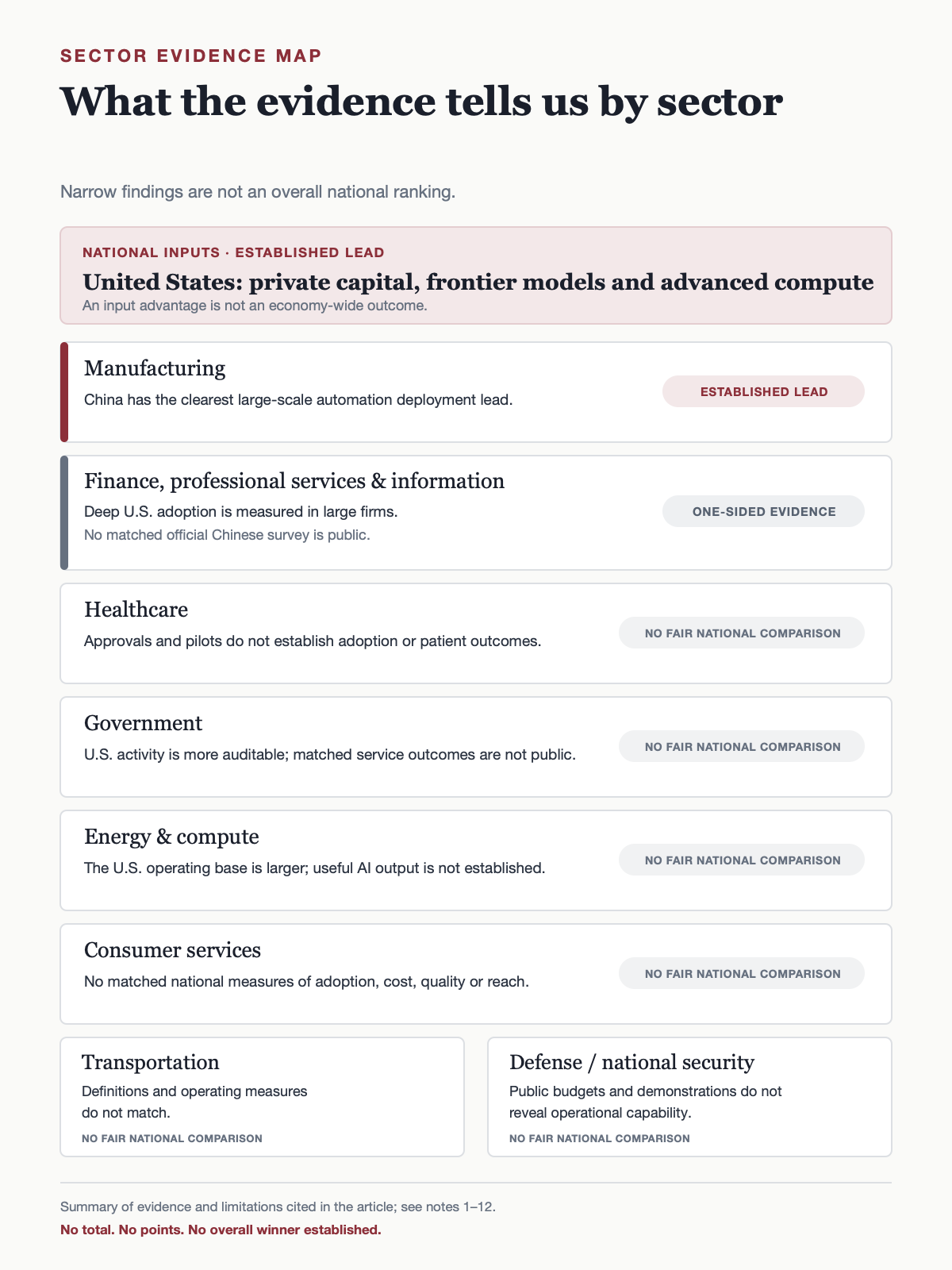
Neither country has demonstrated superior AI outcomes across the whole economy. Healthcare, consumer services, public administration and transportation lack matched national measures. Public budgets, contracts and demonstrations do not reveal classified readiness or operational performance, so the evidence does not support a responsible national ranking in defense.
The contest is one conversion race, not two races with predetermined winners. The United States must turn frontier resources into broader productivity and physical deployment. China must turn industrial scale, infrastructure and lower-cost systems into reliable outcomes while overcoming limits in advanced chips and transparency.
The race remains open. The winner will not be the country with the best headline number. It will be the country that converts its advantages into useful, repeatable results across the most important parts of national life.
Sources
- Stanford HAI, 2026 AI Index and Economy, 2026.
- The White House, “America’s AI Action Plan”, July 2025, and “Accelerating Federal Permitting of Data Center Infrastructure”, July 23, 2025; U.S. Department of Energy, “DOE Announces Site Selection for AI Data Center and Energy Infrastructure Development on Federal Lands”, July 24, 2025; U.S. Department of Commerce, “CHIPS Manufacturing USA Institute for Digital Twins”, January 3, 2025.
- Stanford HAI, Inside the AI Index: 12 Takeaways, 2026.
- WIPO, GenAI Innovation Soaring, 2026.
- International Federation of Robotics, US Robot Industry Returns to Double Digit Growth, 2026.
- U.S. Census Bureau, The Microstructure of AI Diffusion, April 2026.
- FDA, Artificial Intelligence-Enabled Medical Devices, updated 2026.
- China NMPA, Measures Supporting Innovative High-End Medical Devices, 2025.
- Stanford HAI, AI Index 2026: Medicine, 2026.
- U.S. GAO, Generative AI Use and Management at Federal Agencies, July 2025.
- IEA, Energy and AI: Executive Summary, 2025.
- Artificial Analysis, Artificial Analysis Intelligence Index v4.3, September 7, 2026.